
In this article:
- What Unito syncs from ServiceNow
- Supported fields for ServiceNow work items
- Additional features
- Other documentation
This article covers Unito’s new flow builder, available for selected Enterprise plans starting December 1, 2025. Contact us if you want these enabled in your workspace.
For the classic flow builder, see this guide.
What Unito syncs from ServiceNow
Unito syncs records (e.g., incident, tasks, or cases) from ServiceNow tables by linking individual fields from these records to items in other tools (e.g., Asana tasks, Jira issues, Salesforce work items).
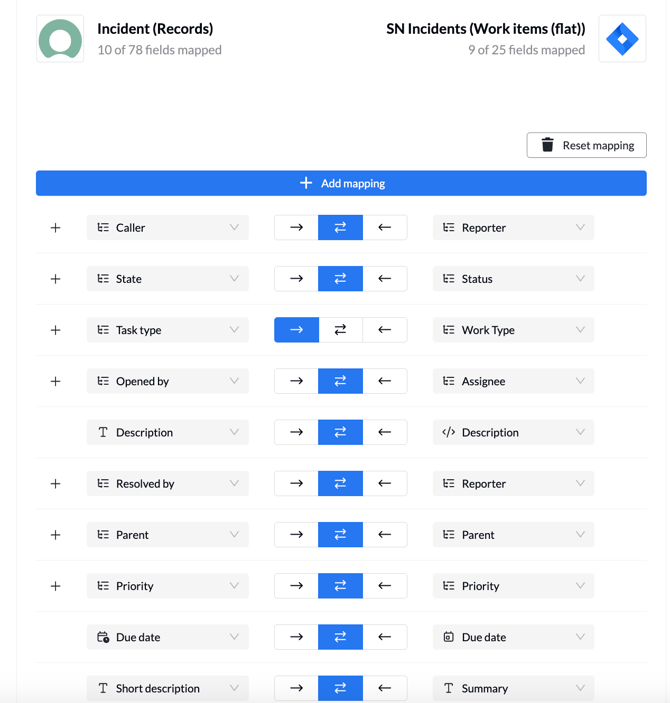
Supported fields for ServiceNow records
Unito can sync most native or custom fields in ServiceNow. Many of them can also be used in rules. If you have an Enterprise plan and need to sync a field or build a rule that Unito doesn’t support yet, reach out to us so we can activate it with a custom setup.
Field types supported by Unito include:
- Number fields
- Text/string fields
- Choice fields (i.e., single select)
- Date and time fields
- User fields
- Boolean fields
- Reference fields
Additional features
Unito’s ServiceNow integration also supports the following features:
- Copied attachments: Unito can copy attachments between ServiceNow and other tools that support this type of attachment. You can learn more about this here.
- Mixed hierarchies: Mixed hierarchies allow you to sync multi-level relationships between work items of different types while maintaining parent-child relationships across tools such as Request/Requested Items, Incident/Incident Task, Change Request/Change Task and more.
- Lookup fields: Unito can sync lookup fields from ServiceNow.
- Rich text: Unito supports rich text for all rich text fields in ServiceNow.
- Comments and work notes: Unito syncs both public comments and internal work notes from ServiceNow records.
- Supported ServiceNow environments: Production instances, sub-production (sandbox) instances, and Personal Developer Instances (PDI) are all supported.